
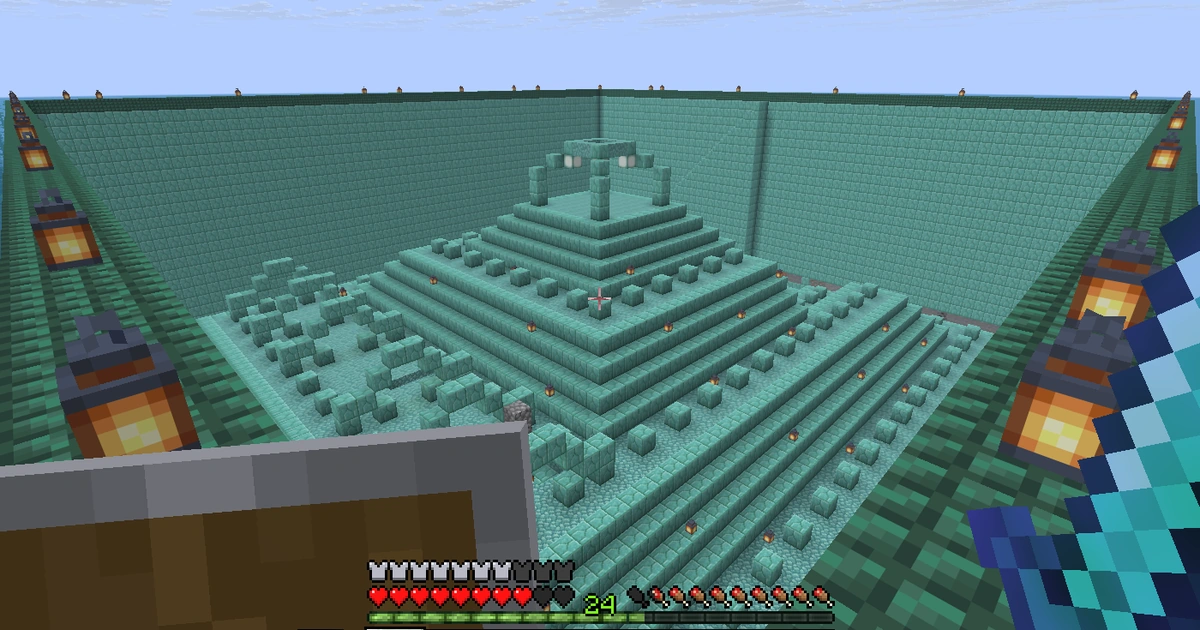
Greetings.
I am a man in a suit who has fallen into the world of Minecraft.
What would something on the seabed look like if I could stand on the ground and look up at it?
Today I’m revisiting an ocean monument I explored before. I’ll watch the view change as the water level falls inside its enclosure, then walk down to the dry seabed.
I’m playing Java Edition 1.21.11.
Back to the Monument Beneath the Sea
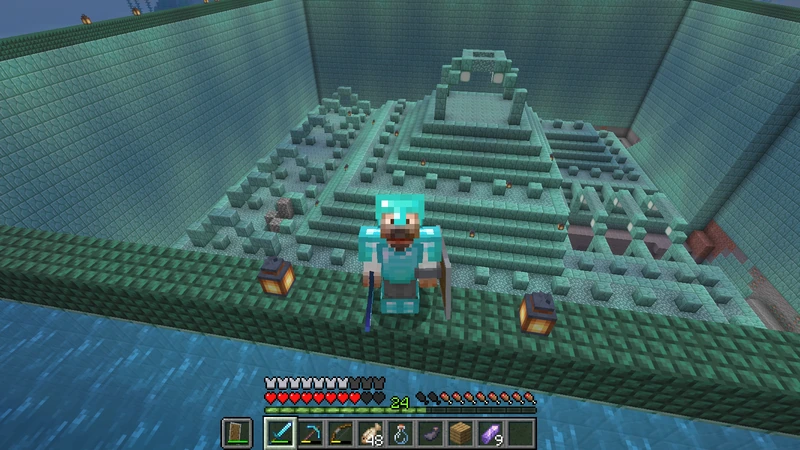
First, a picture with the drained monument behind me—a look ahead at the finished view.
I’m standing on the wall around it. There’s blue sea in front of me, yet behind me the monument is exposed beneath the sky. Water on one side, open air on the other, right next to each other.
In the previous episode’s undersea observatory, I looked at the sea through glass. Today I want to see how this familiar building looks when the water level around it changes.
Let’s go back to the view while it’s still underwater.
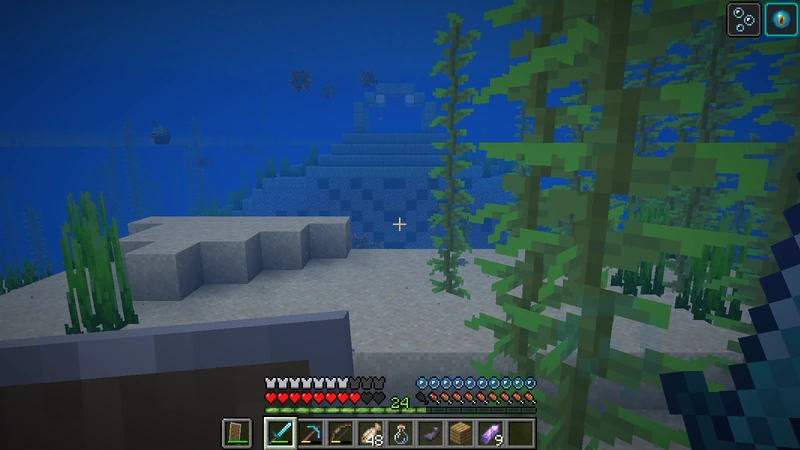
I drink one Potion of Water Breathing and dive into the sea.
The monument is a faint shape beyond the kelp, with guardians swimming above it. Through the blue water, the edges of the tiers and the farther parts of the building seem to blend into their surroundings.
This is the ocean monument I explored in Episode 65. Back then I approached it through the water. This time I’d like another look at the building from outside.
First, I take in how it looks while it’s still beneath the sea.
The Water Level Falls Inside the Walls
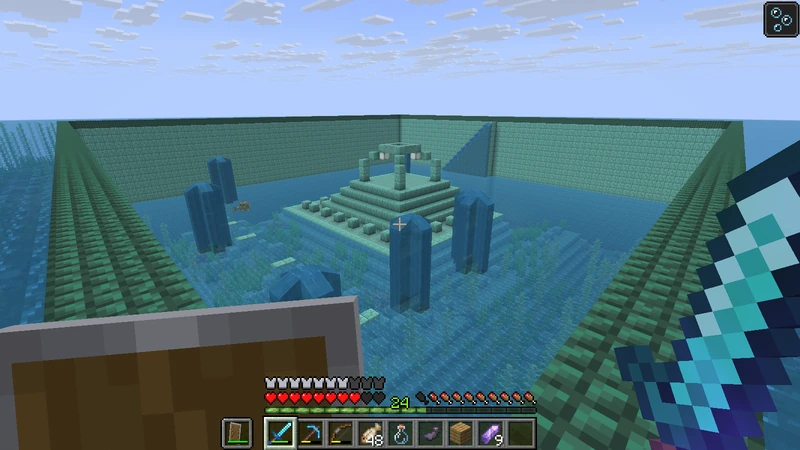
As the water level falls inside the enclosure, the monument’s upper tiers emerge.
The blurred outline gains a clear edge. The top is beneath open sky, while the lower tiers are still underwater. More of the same building becomes visible, making its shape easier to understand.
There’s still water around the monument within the square walls, with more tiers below the surface. This isn’t the end of the change yet.
The layers I couldn’t see all at once while swimming closer are gradually coming into view.
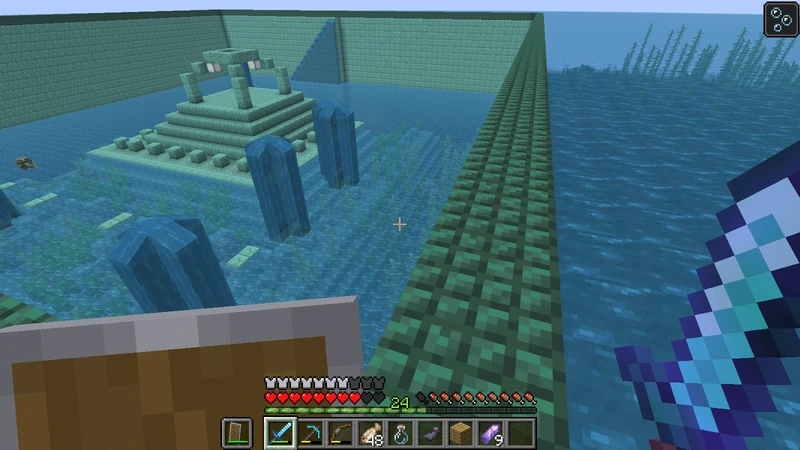
Looking across the wall makes the difference between inside and outside clear.
On the right is the sea I was diving in, its surface still at the same height. Only the water inside the enclosure on the left is lower. There’s now a drop where the sea used to continue across the whole view.
The enclosure measures 64 by 64 blocks on the outside. Its walls mark the boundary between the sea and the changing view around the monument.
The building already looks different from above, but having the original sea beside it shows how far down I can now see.
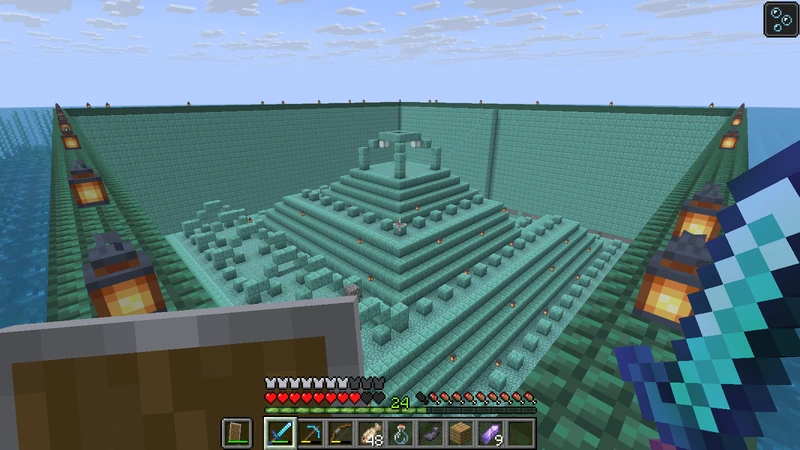
The monument’s outline is much clearer now!
From the top that first emerged to the tiers spreading beneath it, I can see the layers of the structure. Surrounded by lantern-lined walls, the underwater ruin now stands in front of me as a large building.
The sea outside remains in place, and some water remains inside the monument too. I’m leaving the interior unexplored today, to enjoy the outside and the view from its foot.
From above I can take in the shape, but how tall will those tiers look when I’m standing beside them? Time to walk down and find out.
Down the Northern Stairs to Look Up from Below
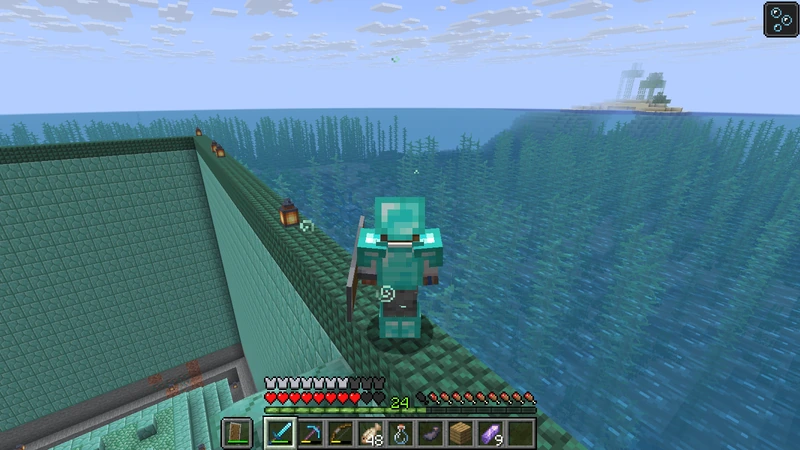
From the top of the wall, I head for the northern stairs.
The sea is on my right and the inside of the enclosure on my left. What looked like neighboring parts of one scene now lies at quite different heights.
Previously, going down into the sea meant swimming. Today I can follow stairs along the wall and put my feet on the ground.
Up here I’ve been looking at the building’s shape; below, the walls and tiers will be much closer. I’d like to take in the change in height as I walk.
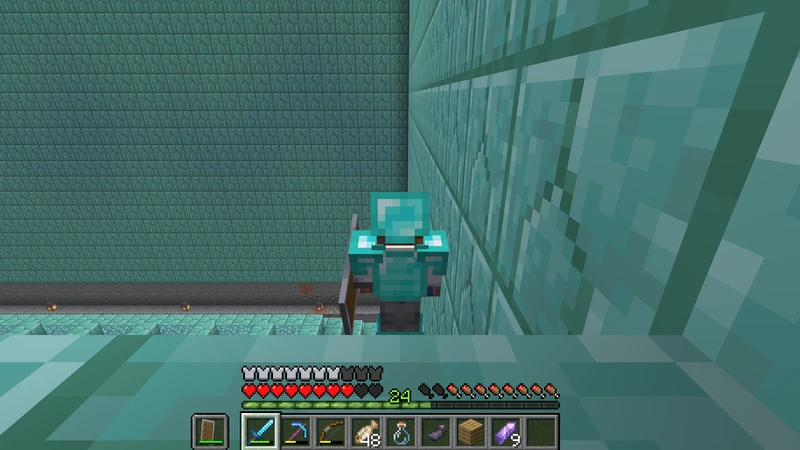
This morning picture is from another walk down the northern stairs after completion.
Following the wall downward brings the dry seabed, monument tiers, and lanterns into view. The picture doesn’t show the whole staircase, but having me in it makes the wall’s height easier to appreciate.
The tall wall continues beside me while the steps lead toward the seabed. I can walk down, staying dry, into somewhere that was sea. That feels more real as I descend.
The depth I couldn’t quite grasp from above is now a wall right beside me.
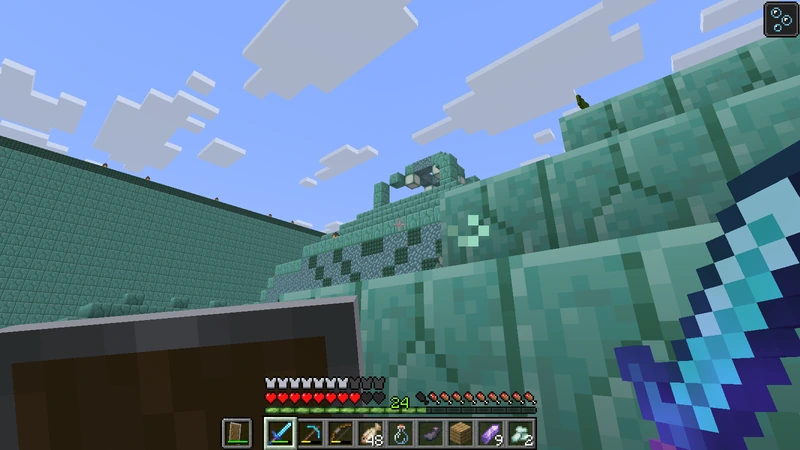
Here’s the view from my first walk to the northern foot of the monument.
Looking up, I have prismarine tiers immediately in front of me, with blue sky and clouds over the building. The structure I was seeing through water is now something I can look up at from the ground.
Above, I could see its overall outline. Down here, the nearest tiers loom in front of me. That difference in height isn’t something I get simply by enlarging the same picture.
It feels strange to have sky rather than water overhead.
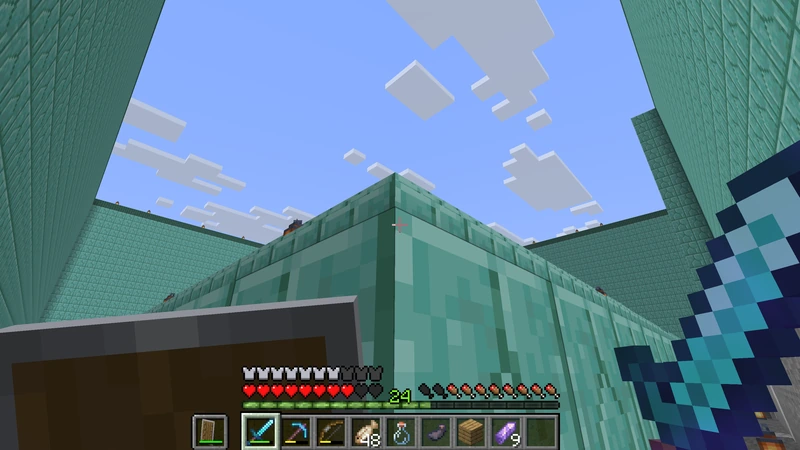
Another view from the seabed after completion, looking up at a corner of the monument and the enclosure.
Beyond the corner, the wall rises toward the sky. The lanterns along its top look a long way away from down here.
The space between the monument and the wall is narrow; it isn’t somewhere I can stand back and fit the entire building into one view. Instead I notice the size of the nearby tiers and the height of the walls.
Perhaps that upward angle, as much as the ground beneath my feet, is what makes it feel like I’m standing on the seabed.
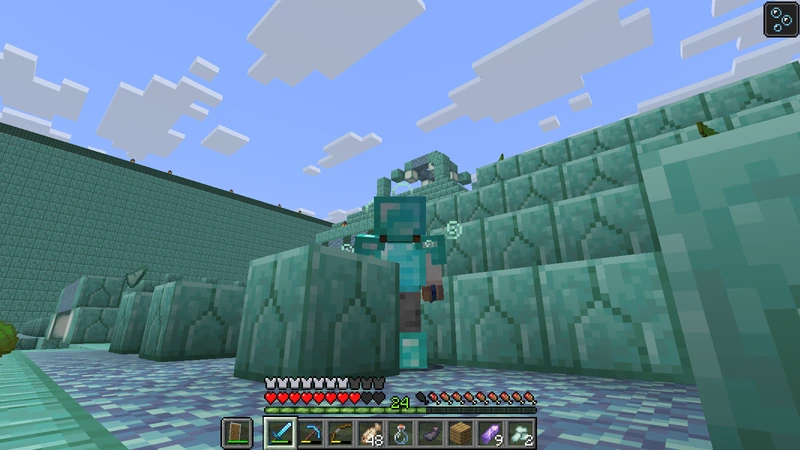
On that first visit to the foot of the building, there’s a rear-view picture in front of the tiers too.
Even the nearest tier looks substantial beside me. It’s quite different from the sense of breadth I had looking down from the wall.
I walk partway around the western side, but don’t complete a circuit. Today I’m staying outside, seeing from below the shapes I looked at from above.
I used to face this monument while swimming; now I’m standing in front of it on the ground. There’s rather a lot of looking up for this fellow.
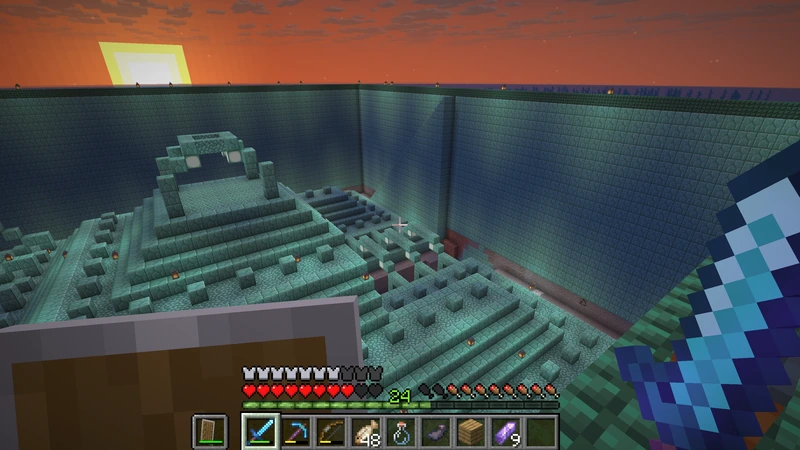
To finish, let’s turn back a little to the view after completion at sunset. This is a different moment from the morning walk down the stairs.
The sun sits low beyond the wall, with lantern light on the monument and around the enclosure. Where I noticed the tiers in daylight, I now see something like a lantern-lit courtyard of ruins.
I’ve seen the monument dimly through water, looked down over it, and looked up from its foot. The same building looks remarkably different as the water level and my viewpoint change.
Next time I come here, I’d like to think about how I could use this place in its new form.
That is all for this time.
Greetings.